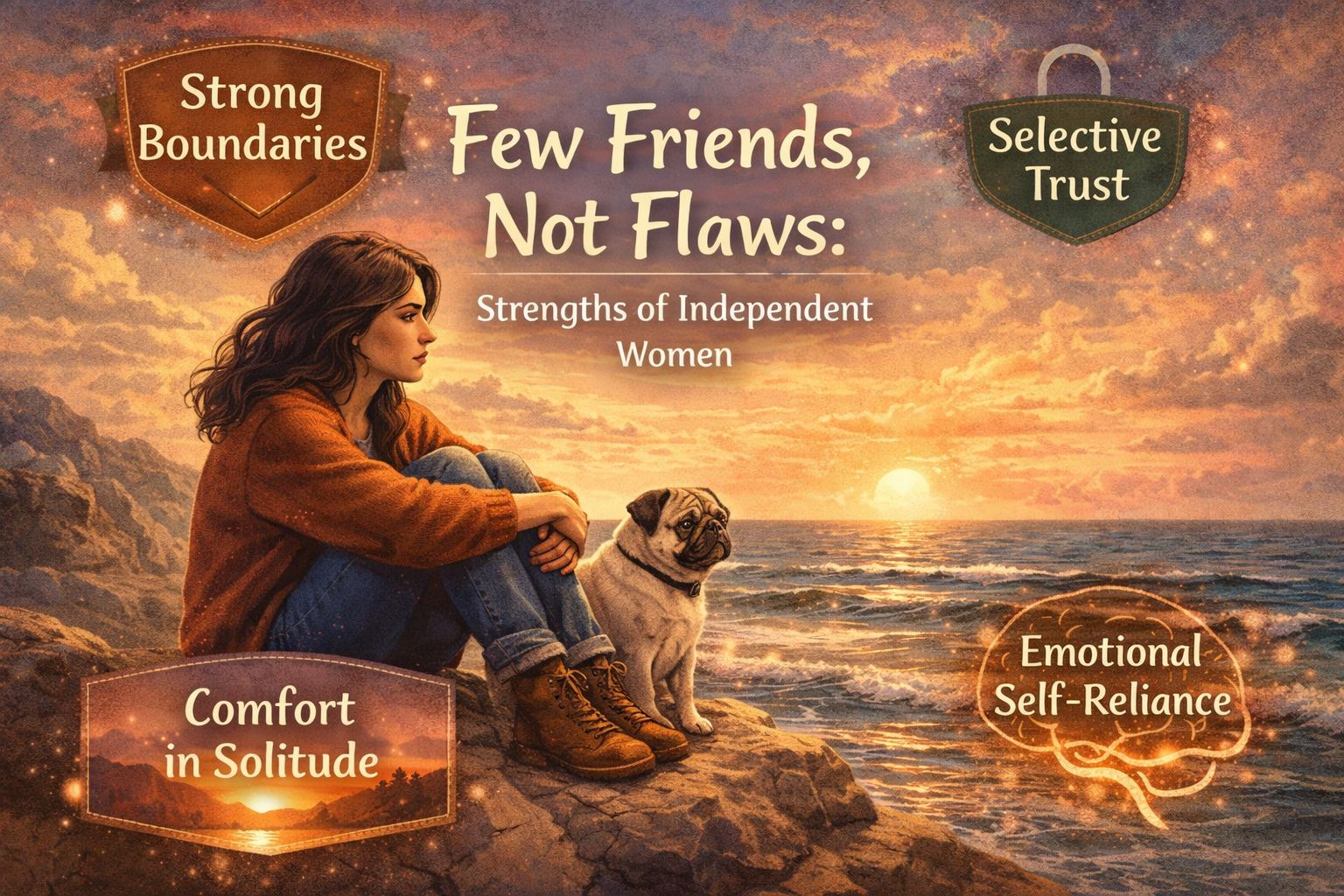
Few or no friends is not a flaw
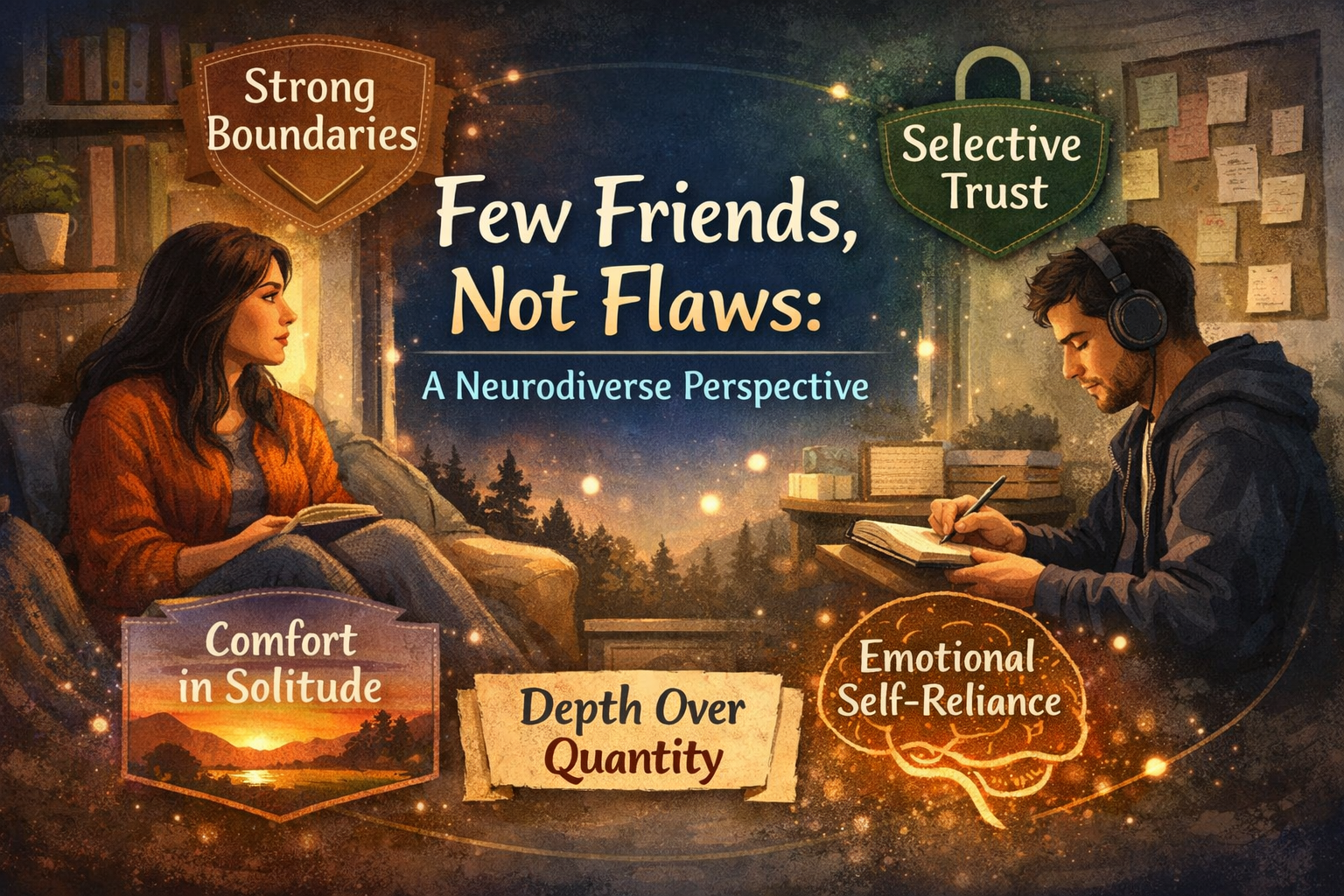
“Few or no friends” doesn’t mean “something’s wrong” — A Neurodiverse Perspective
There’s a quiet narrative in our culture that says: if you don’t have a wide circle of friends, something must be off:
✨️You’re too guarded.
✨️Too intense.
✨️Too independent.
✨️Too picky.
✨️Too much.
But what if none of that is true?
What if having few or even no close friends at certain stages of life isn’t a flaw… but a pattern rooted in self-awareness, lived experience, and nervous system wiring?.
This is especially true for many neurodiverse men and women.
Let’s talk about it.
Independence Isn’t Isolation
Many neurodiverse adults grow up learning early that they must rely on themselves.
If you process the world differently, whether that’s autism, ADHD, sensory sensitivity, or simply a brain that runs deep you often become highly self-sufficient. Not because you don’t want connection. But because connection has sometimes felt confusing, draining, or unsafe.
You learn to:
Solve your own problems
Regulate your own emotions
Entertain yourself
Sit comfortably in solitude
That’s not emotional coldness. That’s adaptation.
And independence can look like distance to people who equate closeness with constant contact.
Selective Trust Is Often Hard-Won
Many neurodiverse individuals have experienced:
✨️ Being misunderstood
✨️ Social exclusion
✨️ Bullying
✨️ Masking to fit in
✨️ Betrayal when they finally did open up
After that, trust doesn’t come cheaply.
And honestly? That makes sense.
Being selective about who gets access to your inner world isn’t dysfunction, it’s discernment.
When your nervous system has learned that connection can equal overwhelm or hurt, caution becomes wisdom.
Solitude Can Be Regulating
For some people, socialising fuels them.
For others, especially those with sensory sensitivity or social processing differences, it drains them fast.
Solitude can feel:
✨️ Quiet
✨️ Predictable
✨️ Safe
✨️ Restorative
It allows decompression from masking, overstimulation, and social performance.
Choosing solitude isn’t the same as being incapable of friendship. Sometimes it’s about protecting energy.
And if your internal world is rich, with ideas, creativity, special interests, deep thinking then you may not feel the same urgency for frequent social contact.
That doesn’t mean you don’t care about people.
It means your threshold is different.
Emotional Self-Reliance Is Not Emotional Avoidance
A lot of neurodiverse adults become highly emotionally self-contained.
✨️They process internally.
✨️They analyse.
✨️They reflect.
✨️They self-soothe.
Outsiders might interpret this as aloofness.
But often it’s competence.
If you’ve learned that others don’t always “get” you, you may have stopped expecting them to hold your emotional world properly. So you learned to hold it yourself.
That’s strength.
The only question worth gently exploring is:
Is this self-reliance a choice, or a shield you no longer need quite as tightly?
The Difference Between Loneliness and Alignment
Here’s the key distinction:
Are you lonely?
Or are you simply not interested in surface-level connection?
Many neurodiverse people crave depth, not quantity.
🙏One real conversation over ten polite ones.
🙏One person who understands your mind over a crowd who doesn’t.
And if that depth isn’t available, you might choose your own company instead.
That’s not social failure.
That’s standards.
When It Does Hurt
Let’s be honest though, independence doesn’t cancel the human need for belonging.
There can still be moments of:
✨️Watching others move in groups
✨️Feeling slightly outside
✨️Wondering if you missed a rule book everyone else got
That ache is valid.
It doesn’t mean you need to change who you are.
It may just mean you need environments where your wiring makes sense.
✨️ Neurodiverse-friendly spaces.
✨️ Interest-based communities.
✨️ Low-pressure connection.
✨️ People who value depth over noise.
The goal isn’t to become more socially acceptable.
It’s to find resonance.
You Are Not “Too Much” or “Not Enough”
If you have few friends, ask yourself this:
✨️Do I actually want more connection?
✨️Or do I just feel judged for not having it?
There’s a big difference.
Having a small circle, or none for a while, can reflect:
✨️Strong boundaries
✨️Deep processing
✨️Past hurt
✨️High standards
✨️Energy awareness
✨️Authenticity over performance
None of those are character defects.
They’re traits often found in thoughtful, self-aware, neurodiverse adults.
A Gentle Reframe
Instead of asking,
“Why don’t I have more friends?”
Try asking,
“What kind of connection genuinely fits me?”
✨️Quality over quantity.
✨️Safety over popularity.
✨️Depth over noise.
You are allowed to build connection in a way that matches your nervous system, not social expectation.
And if you’re someone who has survived betrayal, masked your differences, carried yourself emotionally for years, of course you’re selective.
That’s not broken.
That’s wise.
And when the right people do arrive, the ones who understand pacing, honesty, space, and depth, you won’t need to perform.
You’ll just be.
And that kind of connection?
It’s rare…but its real.